At a glance
- Follow the appliance’s permitted-fuel instructions.
- Ready to Burn wood certification indicates moisture of 20% or less when supplied.
- Check stored logs appropriately; appearance and a dry outer surface are not enough.
Judge the moisture, not just the label
“Seasoned” describes air drying; “kiln dried” describes a controlled drying process. Neither tells you what happened to the logs after drying. A delivery stored badly can become wet, and the outside of a log does not tell you the moisture deeper inside.
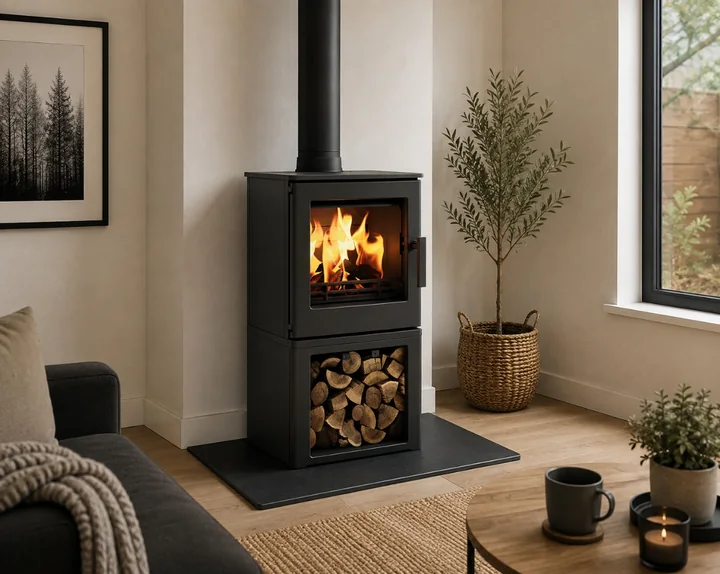
Buy fuel that matches the appliance instructions, in lengths that fit the firebox, and plan where it will be stored before it arrives. Good fuel handling starts with the delivery route and a suitable store, not at the moment you want to light a fire.
Further reading: FireFX — Echo and Eton installation instructions · Charlton & Jenrick — Understanding and using moisture meters
What Ready to Burn means in England
For wood fuel sold in volumes below 2 cubic metres in England, GOV.UK requires Ready to Burn certification, confirming moisture content of 20% or less. Look for the logo, supplier name and certification number. These sales requirements apply in England; check the relevant local requirements elsewhere in the UK.
For sales of 2 cubic metres or more, certification is not required by that rule, but suppliers must provide the prescribed drying, storage and checking notice. Buying a larger load therefore does not establish that it is ready to put straight into the stove.
Fuel certification and smoke-control permission answer different questions. In a smoke control area, wood still needs an appropriate exempt appliance and must be a fuel the manufacturer permits.
Further reading: GOV.UK — Selling wood for domestic use in England · GOV.UK: smoke control area rules
Check several logs on a fresh inner face
The Charlton & Jenrick guidance recommends checking newly exposed wood inside a split log and sampling several logs, rather than relying on one convenient piece or an old outer surface. Follow the moisture meter’s instructions, including any settings relevant to the wood and conditions.
Record enough information to make a reading useful: which delivery, whether the face was freshly exposed and whether the other samples agreed. If readings are unexpectedly high or inconsistent, set that batch aside for further checking or drying instead of averaging away the problem.
A delivery check
- Confirm the supplied fuel and log length match the order and appliance.
- Check the relevant certification details for a small-volume sale in England.
- Sample representative logs using the meter instructions.
- Keep delivery information with any query to the supplier.
- Separate fuel that needs more drying from ready-to-use stock.
Further reading: Charlton & Jenrick — Understanding and using moisture meters · GOV.UK — Selling wood for domestic use in England
Give the store air as well as a roof
Protect logs from rain and ground moisture while allowing air to circulate. A tightly covered damp pile can retain moisture; a store needs to keep weather off without sealing the wood into a wet pocket. Arrange stock so older dry logs remain accessible when a new delivery arrives.
Think through winter use. The route to the door should be practical in poor weather, and carrying smaller amounts may be easier than one heavy load. Keep indoor fuel outside the clearances required around the stove; an attractive stack beside a hot appliance is not automatically a suitable storage position.
Only burn the wood fuel the manufacturer allows. Painted, treated or unknown waste timber is not a substitute for suitable logs. If the fire is behaving poorly despite appropriate dry fuel, do not assume that adding more wood is the answer: the appliance, operation and chimney may need attention.
Further reading: GOV.UK — Selling wood for domestic use in England · FireFX — Echo and Eton installation instructions
Sources & useful checks
Source review: 16 October 2026. Sources are listed with their own access dates. Check the current guidance for your address and appliance.
- GOV.UK — Selling wood for domestic use in England ↗ · accessed 16 October 2026
- Charlton & Jenrick — Understanding and using moisture meters ↗ · accessed 16 October 2026
- FireFX — Echo and Eton installation instructions ↗ · accessed 16 October 2026
- GOV.UK — Smoke control areas: the rules ↗ · accessed 16 October 2026